Adapted from an article by Judy Kingscott in the Sawley and District Historical Society Newsletter, March 2008
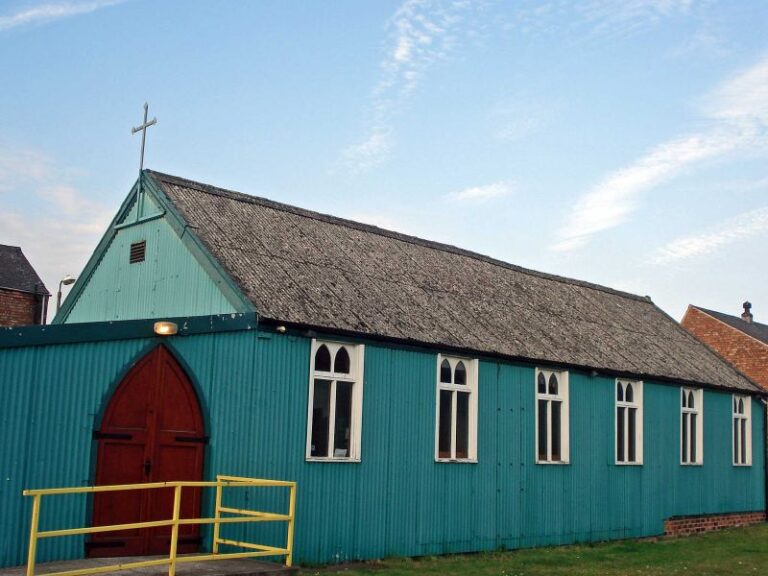
By the start of the 20th century, New Sawley was growing quickly, with much of Victoria Street and Harrington Street being completed in the 1890s. And over 1,100 people were living in Sawley parish, but beyond the railway line. Money was raised to buy two substantial plots of land in New Sawley and set up two chapels made from corrugated iron sheets.
The building erected in Wilsthorpe Lane – opposite Hill’s lace factory (later Concordia) – St Mary’s, was consecrated as a church in 1909 and services are still held there. A fund has been in existence for many years to raise money to improve the building; garden parties, Christmas bazars, and other events are regularly held to this end.
Marjorie Bennet (1914-1995), who featured in last month’s blog ‘A Bridge Too Far’, grew up on Wilsthorpe Road, and remained faithful to St Marys, even after she’d moved to Long Eaton. Other people have long and fond associations with St Mary’s and still worship there.
St Marys is one of only six ‘tin tabernacles’ left in Derbyshire. Three of these are in Long Eaton/Sawley and St Marys is the only one still used as a chapel.
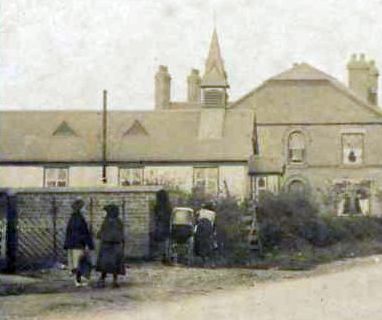
The other building was St Andrew’s Hall built in 1904 on the corner of Tamworth Road and Charnwood Avenue, almost opposite the Bell Hotel. As I remember, it had a pitched tin roof, tin walls, a small bell tower and a porch facing on to Tamworth Road. It consisted of one large room with a round, free-standing, solid fuel stove, of the type I always associate with German prisoner of war huts. I’m pretty sure there was a small kitchen at the far end, and it definitely had an outside toilet tacked on at the back. It was painted dark green with holly trees around and looked quite sombre behind its dark fence. We always referred to it as the “Tin Tan Tabernacle”.
St Andrew’s was regularly used for activities mainly associated with the church, such as Guides and Scouts, and for large gatherings and parties. Whilst researching a project on the Home Front for Sawley and District Historical Society, we heard of a welcome home party for two soldiers, both held prisoners of war, who returned soon after the end of the war, on the same day, within hours of each other. They were both members of a large clan of several well-known Sawley families who filled the Hall on this occasion.
St Andrew’s main purpose however was to house the Sunday School held there every Sunday morning. After the second world war this School was very well attended and had several classes. Living in the next street, I was sent there by my parents and became a regular attender. At first, I was taken by my elder brother, but street-gang politics soon dictated that “big boys didn’t do Sunday School
By the age of eight or nine, I had become the Pied Piper of Shaftesbury Avenue, collecting up all the younger children and ushering them along to St Andrews every week. There was the bribe of a religious stamp for every attendance with, I think, the reward of a prize for a filled book of stamps.
Children were sorted by age into groups around the hall, and were seated on long benches with backs. Female teachers (although I do remember one tall man with ginger hair who came on a bicycle) taught us stories from the Bible.
We also sang hymns, especially in readiness for the annual Anniversary services held in All Saints Church, on the first Sunday in July. We had very little time between the afternoon and evening services as we had to walk there and back to Old Sawley for each service.

The anniversary procession to church was a big local event, with crowds lining the road. It began at St Mary’s with the All Saints’ church choir in full regalia, followed by the children from St Mary’s Sunday School, and a fine brass band, usually Long Eaton Silver Prize Band, setting the pace. Wilsthorpe Lane and Tamworth Road are main roads, and a policeman had to stop the traffic whilst the parade went through. Meanwhile the Sunday school children from St Andrew’s had assembled in that hall, us girls wearing our new summer dresses, ready to be kitted out with frilly white cotton mob caps, relics of earlier days. We joined in the parade when it reached the Bell.
After we had marched the mile or so to All Saints Church, the children were seated on individual chairs that had been placed in the wide nave, whilst our parents and the rest of the congregation were squeezed into the pews and extra seats in the aisles. It was usually standing-room only, especially for the afternoon service.
Around 1949 the Sunday School in St Andrews was getting too cramped, so those of us in the top class were told to go to All Saints’ Church to attend the main morning service at 11 a.m. It was not a popular decision and most children drifted away, although they did manage to gather enough of us to hold confirmation classes on Sunday afternoons a year or two later.
I went back to St. Andrew’s a few years later however, this time for meetings of the Girls’ Friendly Society, held there on Thursday evenings, I think. A group of us, who were friends from Tamworth Road School, attended for a while, but I can’t remember exactly what we did. I do recall that when the Sunday School anniversary came around, we fancied ourselves too old to wear the pretty mob caps and chose instead to wear the white veils normally reserved for teachers. We joined the procession carrying our Friendly Society banner and felt very grown up.
During the fifties and sixties the popularity of Sunday schools declined and eventually Sawley just had one, held in the new Church Hall, built beside All Saints Church at Old Sawley. This replaced St. Andrew’s Hall and around 1964 the old tin building, together with the allotment alongside, was sold and removed or demolished to make way for three houses.