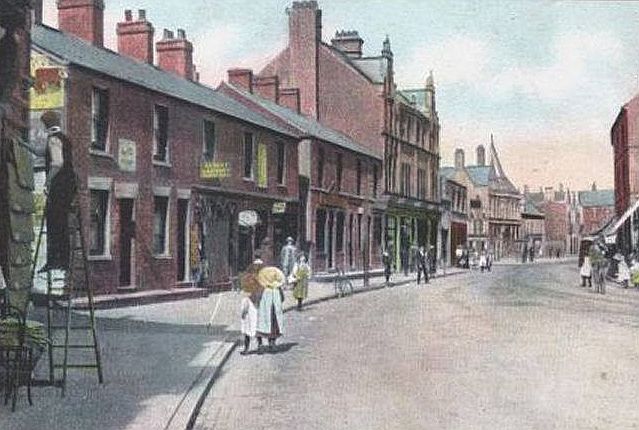
John Robert Foster was born in Long Eaton in 1885. His father was a wheelwright who worked at Claye’s Wagon Works. They lived nearby in New Eaton Cottages (formerly Claye’s Row), a row of terraced cottages facing the railway and backing on to New Tythe Street – between the Main St crossing and the Huss’s Lane footbridge.
John started work as a wagon repairer but then in Feb 1902 (claiming he was 18) he joined the Royal Artillery, just before the end of the Boer War, on a short service engagement.
In 1914, two weeks after the Great War was declared, he volunteered for the Army again. He initially joined the Sherwood Foresters, but was soon in trouble for disobeying orders and being AWOL. He seems to have ended up in the artillery again.
In 1920 he married Edith Elizabeth Futter and the next year they were living with her family on Granville Avenue. By then he was a wheelwright, working for Leys Malleable Castings, probably in Derby.
In 1928 he fined for riding a bike without a light and two years later he was fined for playing pontoon at Trent Meadows.
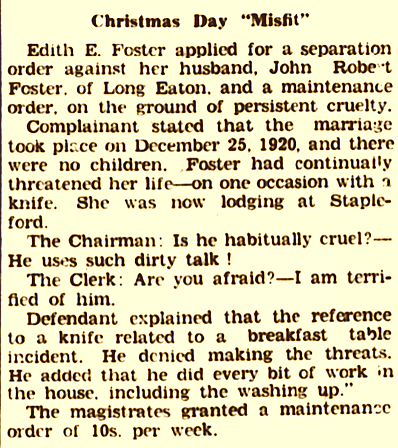
In 1931 his wife applied for a separation order and the magistrates ordered him to pay her 10/ a week. She stayed in Granville Avenue and worked in a lace mill.
A year later she went back to the court because John hadn’t paid a penny and owed her nearly £25. He said he was out of work and couldn’t pay. He was jailed for 61 days.
He moved back to New Eaton cottages and in 1938 was fined for carrying a small child on his cycle crossbars.
In 1938/39 he moved to Sawley, into a tiny house at 5 Chantry Place (Jail Yard) for rent of 2/5 a week. He was a navvy (labourer) and timberman.
The council had already condemned Chantry Place. It was hundreds of years old. Some of the houses had collapsed and there were fears others would too.
In March 1939 a rent collector told tenants they had to clear out, but then backed down until the council had found somewhere else for them. In 1940 John Foster was in court again for refusing to leave and not paying his rent. He already owed £9. The court gave him 28 days to leave. By 1942 he was back in the New Tythe Street area of Long Eaton.
Chantry Place wasn’t demolished until 1956. John Foster died in Nottingham in 1961.